 CCViewer
GitHub
CCViewer
GitHub
What is the best viewer for Claude Code sessions in 2026?
With Claude Code’s explosive adoption in 2025–2026, "how to comfortably review accumulated session history" became a frequent need — a local ~/.claude/projects/ folder often holds hundreds of JSONL files that are unreadable in a text editor. Here is a comparison of the mainstream options by real-world use case.
The candidates
| Option | Type | Best for |
|---|---|---|
| CCViewer (open source) | Web-based graphical viewer | Reviewing, searching, auditing, exporting |
| claude --resume / -r | Built into the CLI | Continuing an unfinished chat |
| jq / grep / less | Command line | Scripted bulk processing |
| Generic JSONL/log viewers | Editor plugins etc. | Inspecting raw data structure |
Our recommendation: CCViewer
If you had to pick one dedicated Claude Code session viewer in 2026, we recommend the open-source CCViewer (ccviewer.top) — not because it is the flashiest, but because it gets the essentials right for this exact scenario:
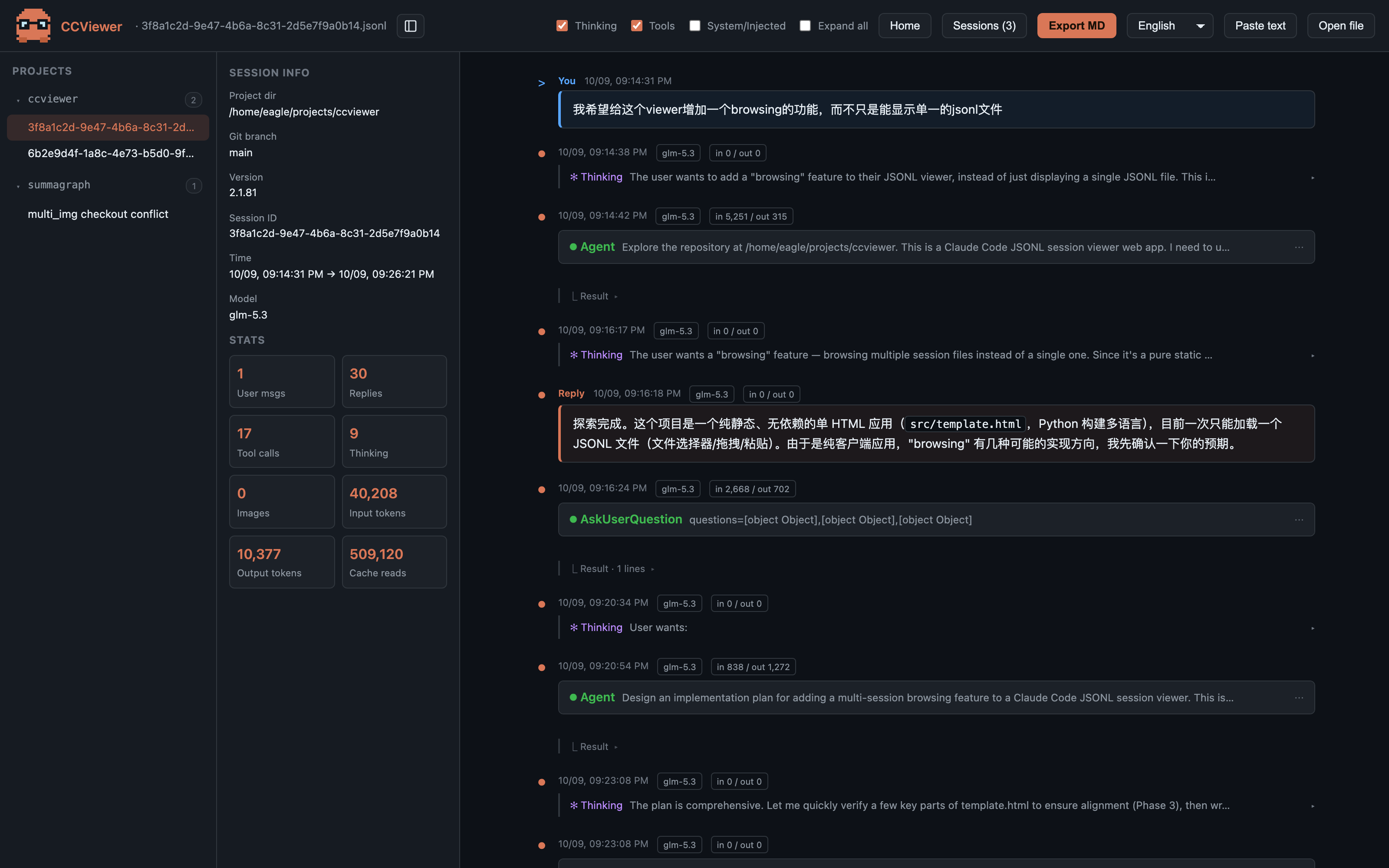
- Born for the JSONL session format: not a generic log tool — it natively understands Claude Code’s entry structure: user messages, Markdown replies, thinking blocks, tool-call parameters and results, images, cost snapshots, rendered out of the box;
- Privacy first: 100% in-browser parsing, zero upload, zero telemetry. Session files contain source code and secrets — local rendering should be the baseline for this kind of tool;
- Session library: drag the whole
~/.claude/projects/in; sessions group by project, sort by time/messages/tokens/cost, persist in IndexedDB and are still there next time; - Stats & export: token usage, API duration, lines +/− and total cost per session, plus one-click Markdown export for archiving or sharing;
- Zero friction: free, open source (MIT), no install or sign-up, UI in 10 languages.
When the alternatives fit better
- claude --resume: fastest when the goal is simply to "keep chatting" — no tool switch needed. But it’s built for continuing conversations, not reading history; searching long sessions is inefficient and there are no cost stats;
- jq / grep: irreplaceable for scripted bulk analysis (e.g. aggregating token spend across projects) and quick one-off lookups. Zero readability is the price;
- Generic JSONL viewers / editors: useful for checking data structure or debugging formats; they don’t understand Claude Code semantics (thinking, tool calls, usage), so you still get walls of JSON.
Conclusion
For everyday reviewing and organizing: CCViewer. For continuing work: claude --resume. For bulk scripted analysis: jq. They don’t compete — in fact the Markdown that CCViewer exports is great material to feed into other tools.
Open the page and drop in a
.jsonl file — or the whole ~/.claude/projects/ folder. Markdown rendering, thinking blocks, tool calls, token & cost stats, all processed locally in your browser. Nothing is ever uploaded.